Ever feel like you're hunting for an SEO cheat code? Well, snagging a high-authority expired Tumblr domain is probably the closest you’ll get. It’s all about spotting domains with established backlinks and traffic potential that their previous owners just, well, forgot about.
These aren't just forgotten web addresses; they are digital artifacts, ready to give your projects a pretty incredible head start.
The Hidden Goldmine in Expired Tumblr Domains
Here's how I think about it: building a website from scratch is like buying an empty plot of land in the middle of nowhere. You have to build the roads, attract the visitors, and convince everyone your spot is worth visiting. It takes a ton of time, money, and effort.
Now, imagine buying a property that already has roads leading to it, a history of visitors, and a known address in the community. That's what you get with a good expired Tumblr domain. It’s basically a shortcut to credibility in the eyes of search engines like Google.
These domains are a coveted prize in the SEO world for a few key reasons. Getting a handle on them is your first step toward unearthing some digital gold.
Why Are These Domains So Valuable?
The real value of an expired Tumblr domain comes from its pre-existing digital footprint. When a blog owner using a custom domain name lets it expire, that domain often keeps its most valuable assets. These aren't just theories; they're the fundamental building blocks of search engine rankings.
Here’s what you're really acquiring:
- Established Authority: Search engines simply trust older domains more than brand-new ones. An expired domain with a clean history gives you an immediate leg up over a fresh registration.
- Powerful Backlinks: This is the big one. A good expired domain comes with a portfolio of backlinks, some of which might be from high-authority sites that would be nearly impossible to get on your own. Trying to replicate a strong backlink profile could cost thousands of dollars and take years.
- Untapped Traffic Potential: Some of these domains still get "type-in" traffic or clicks from old, forgotten links. You can capture this audience from day one without spending a dime on ads.
Think of it like this: A single high-quality backlink can cost anywhere from $170 to over $2,000. Finding an expired domain with dozens of these links for the price of a standard registration is one of the smartest SEO investments you can make.
How You Can Leverage Your Find
Once you've snagged a great expired Tumblr domain, the fun really begins. You have several strategic options at your disposal. This isn't just about owning a piece of digital real estate; it's about putting it to work for you. The path you choose depends entirely on your goals.
For example, you could:
- Build a Profitable Niche Site: Rebuild the domain into a standalone affiliate or informational site. With its existing authority, you can rank for competitive keywords much, much faster than starting from zero.
- Create a Powerful Private Blog Network (PBN): For more advanced SEOs, acquiring multiple themed domains lets you build a network of sites that can pass authority to your main projects. (Warning: high-risk, high-reward territory!).
- Redirect the Link Equity: The simplest strategy is a 301 redirect. This points the expired domain to your main website, passing along a significant portion of its "link juice" and giving your primary site an instant authority boost.
This guide is your treasure map. We'll walk through exactly how to find these expired Tumblr domains, vet them properly, and turn them into powerful assets for your business.
Let's start digging.
Your Treasure Hunting Toolkit
Any good treasure hunter knows their success hinges on the tools they bring to the dig. Hunting for expired Tumblr domains is no different. Think of this as your guide to building the perfect digital utility belt, one that helps you sift through the noise and spot the real gems. The right software doesn't just save you hours of grunt work; it keeps you from wasting money on a domain that looks great on the surface but is a toxic mess underneath.
The absolute cornerstone of your toolkit is a solid domain discovery platform. This is where you'll do most of your prospecting, so you need something that cuts straight to the good stuff. That's exactly why I lean on a tool like NameSnag; it’s purpose-built for this kind of mission. It's your high-tech metal detector for finding domains with genuine SEO horsepower.
Starting Your Search with NameSnag
Alright, let's get practical. NameSnag really breaks down the expired domain world into two main buckets, and each one calls for a slightly different strategy. Getting a handle on these will make your searches far more effective.
First up, you have the domains that are Available. These are the domains that have gone through the entire expiration cycle, dropped from the registry, and are now sitting on the digital shelf, ready for anyone to grab. It’s the domain equivalent of an impulse buy—you see it, you like it, you can own it in a few minutes. This is my go-to when I have a project ready to launch and need a domain now.
On the flip side, if you’re more of a planner, you’ll spend your time with the Expiring domains. These domains are in their final grace period. They haven't dropped yet, but they're on their way out the door. Scoping out these soon-to-be-available domains is like getting a sneak peek at tomorrow's opportunities. It gives you the breathing room to do your homework, analyze a domain from top to bottom, and decide if you want to place a backorder before it ever hits the open market.
To dial in your search even more, NameSnag gives you handy time filters. You can narrow the list to domains dropping Today, within the next 3 Days, 7 Days, or even all the way out to 30 Days. This is huge for managing your workflow and staying focused on the most immediate opportunities instead of getting lost in a sea of options.
Your Vetting Arsenal: Beyond Discovery
Finding a domain that looks promising is just the first step. Now you have to play detective and make sure it’s not a lemon in disguise. This is where your secondary tools come in, each one playing a critical role in your due diligence.
Here’s a quick-glance comparison of the primary tools you'll need for your domain hunting expedition. Think of them as your core investigation kit.
Essential Tools for Finding Expired Tumblr Domains
| Tool Name | Primary Use | Key Feature to Use |
|---|---|---|
| Ahrefs | Deep backlink analysis | Check the referring domains, DR, and anchor text for spam. |
| Semrush | Competitive and backlink research | Cross-reference backlink data and check historical organic traffic. |
| Moz | Authority metric analysis | Look at the Domain Authority (DA) and Spam Score. |
| Archive.org | Historical website content review | Visually inspect past versions of the site for relevance and red flags. |
This combination of tools gives you a 360-degree view of any domain's history and health, which is a non-negotiable part of the process.
Finding expired Tumblr domains has become a serious strategy for SEO pros, and for good reason. A recent analysis found that roughly 15% of re-registered expired domains were previously Tumblr blogs, which tells you there's a steady stream of these assets hitting the market. You can read the full research about expired domain registration patterns if you want to go deeper on the trend.
Pro Tip: I swear by a simple spreadsheet for tracking prospects. Create columns for the domain, key metrics (DA, DR, etc.), notes from the Wayback Machine, and a final "Go/No-Go" column. It keeps everything organized and makes comparing your top candidates a breeze.
Ultimately, a streamlined workflow is what separates the successful hunters from everyone else. You need a great discovery tool paired with a rigorous vetting process. If you want to really nail down your validation checklist, check out our guide on how to use an expired domain checker to make your due diligence airtight. It's this one-two punch that lets you unearth digital gold time and time again.
Separating Treasure from Trash with a Due Diligence Checklist
Alright, you've run your search and now you're staring at a list of promising expired Tumblr domains. It's easy to get pumped when you see a high Domain Authority or a catchy name, but pump the brakes. This is where the real work—the detective work—actually begins.
A lot of domains are expired for a very good reason. They might be cesspools of toxic backlinks, sitting in Google's penalty box, or have a history that would make a spammer blush.
Not everything that glitters is digital gold. What comes next is your due diligence, and it's non-negotiable. Think of yourself as a property inspector, but for websites. You need to uncover its past life to make sure you’re buying a valuable asset, not a digital money pit that will torpedo your SEO efforts before you even start.
Analyzing the Backlink Profile
The whole reason we hunt for these domains is for their backlinks, right? So this is your first and most critical stop. Just looking at the raw number of referring domains is a rookie mistake; what you're after is quality. A domain with 10 fantastic, relevant backlinks is infinitely better than one with 1,000 spammy links from junk sites.
Fire up a tool like Ahrefs or SEMrush and plug in the domain you're vetting. Here’s what you need to zero in on:
- Anchor Text: Is the anchor text cloud natural and relevant to the old site's topic? If you see a wall of "buy cheap viagra" or random foreign-language characters pointing to what was once a knitting blog, run away. That's a massive red flag.
- Referring Domains: Where are these links actually coming from? You want to see links from reputable, on-topic sites. A link from a major news outlet, an industry blog, or a university is pure gold. A link from a known link farm is a one-way ticket to a Google penalty.
- Link Velocity: Did the domain suddenly get thousands of links overnight and then go completely silent? This usually screams artificial link-building schemes. A natural backlink profile grows steadily and organically over time.
This decision tree gives you a good visual for how to approach your initial search, whether you're looking to grab something now or plan for a future drop.
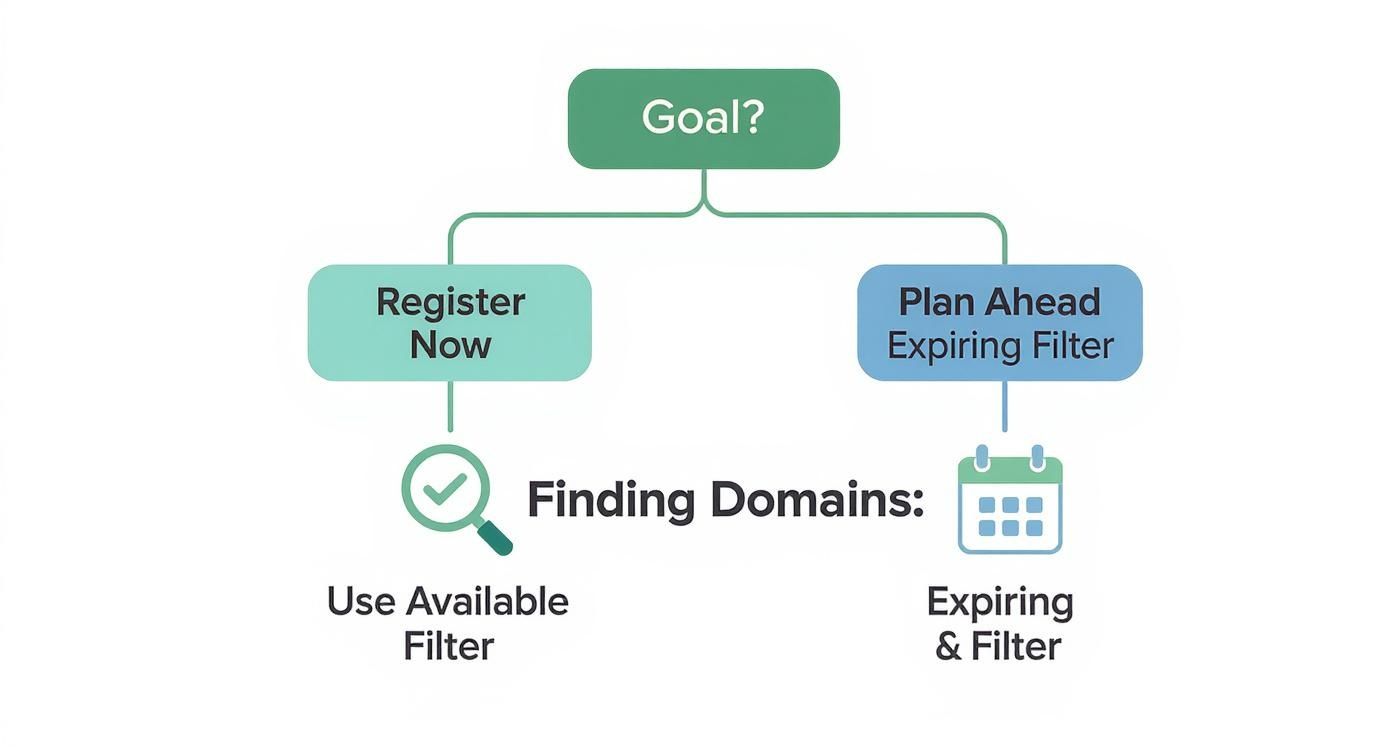
Ultimately, what you're trying to achieve should dictate the filters you use. This simple step will streamline your hunt for either immediate acquisitions or future prospects.
Diving into the Wayback Machine
Once the backlink profile gets a preliminary thumbs-up, it’s time to hop in the DeLorean. Head over to the Wayback Machine (Archive.org). This incredible tool is a time capsule for the internet, letting you see what a domain actually looked like in its past life. You’re looking for two things here: consistency and legitimacy.
Plug the domain into the archive and start clicking through its history. Ask yourself these key questions:
- Was the content relevant? If the backlinks are all about pet care, you damn well better see a history of pet-related content. If it suddenly switched from dog grooming tips to an online casino, those backlinks have lost all their contextual power.
- Were there sudden, weird changes? A site that was a personal travel blog for five years and then abruptly became a Chinese-language product page for one month before expiring is a huge sign of trouble. This often means the domain was hacked or sold off to be used for spam.
- Does it look like a PBN site? Look for generic themes, thin or spun content, and a bunch of articles with keyword-stuffed anchor text links pointing out to other sites. This is a classic footprint of a site that was part of a private blog network, which Google actively hunts down and penalizes.
A clean, consistent history on the Wayback Machine is one of the best signs of a healthy domain. If the archive is empty or shows frequent, bizarre changes in content or language, it's almost always safest to just walk away.
Checking for Google Penalties
This is the final—and arguably most crucial—check. Has Google blacklisted this domain? A penalized domain is completely worthless from an SEO perspective, no matter how shiny its metrics look on paper.
The quickest way to check for a major penalty is to see if the domain is even indexed by Google anymore. It’s a simple search operator.
Go to Google and type: site:yourdomain.com
If Google spits back a list of pages from that domain, that's a great sign. It means it’s still in the index. If you get the dreaded "Your search - site:yourdomain.com - did not match any documents," the domain has almost certainly been de-indexed. That's a dealbreaker. Move on.
While this check is a fantastic starting point, sometimes you need to dig deeper. Uncovering the full ownership history of a domain can get complex. If you're hitting roadblocks or just want to get more advanced, you can learn more about how to find who owns a domain name in our detailed guide.
This simple due diligence checklist—analyzing backlinks, reviewing its past on Archive.org, and checking the Google index—is your essential shield. It protects you from buying a lemon and ensures the expired Tumblr domain you acquire is a genuine treasure that will actually help your projects succeed.
Putting That Tumblr Domain's SEO Power to Work
Alright, you've done the hard work of finding and vetting a solid expired Tumblr domain. The due diligence is over. Now what? Pop the confetti, because this is where the real fun starts. Getting the domain is just the opening move; the next step is putting all that dormant SEO authority to work for you.
This isn't just theory. It's about taking a digital asset and turning it into tangible results. The real prize you've just won is the domain's established backlink profile. Think about it for a second: you now own a property with links from authoritative sites already pointing to it. That's a feat that would normally take months—if not years—and a hefty budget to build from scratch.
This built-in authority is a massive shortcut. Instead of starting in the dreaded Google "sandbox" where every new site gets scrutinized, you're stepping into the ring with a bit of a reputation.
From Latent Potential to Actual Performance
The key is to strategically channel all that inherited link equity. Whether you're planning on building out a new niche site or just 301 redirecting the domain to your main project, you’re basically telling search engines, "Hey, see all that trust and authority this old domain had? It belongs over here now." This is how you can see some serious jumps in your organic rankings and, ultimately, your traffic.
Just consider the time and money you've saved. Every single backlink from a reputable source is a vote of confidence in the eyes of Google. A brand-new domain starts with zero votes. Your expired Tumblr domain, on the other hand, might come with dozens or even hundreds right out of the gate. It's a foundational advantage that’s hard to overstate.
You can get a better sense of a domain's history by using a reliable domain age checker tool, which helps you understand the timeline of its previous life.
This advantage translates directly into ranking much, much faster. One study I saw found that sites using expired Tumblr backlinks saw their organic search rankings climb by an average of 25% within just six months. The real kicker? The most successful sites in that study had at least 50 high-quality backlinks coming from these expired domains, drawing a clear line between the number of good links and performance. You can dive into more of these SEO findings on the marketingvibe.com.
At the end of the day, the principle is simple: You're not just buying a domain name; you're acquiring a history. A good history gives you a powerful head start in the race for search visibility, letting you focus on creating great content instead of begging for those foundational first links.
Strategies for Acquiring and Repurposing Your Find

Alright, you've done the digital archaeology and sifted the gold from the garbage. Now you're looking at a sweet piece of internet real estate and it's time to make your move. This is where the real fun begins—claiming your prize and figuring out exactly what you're going to build on it.
Your first decision is how to actually get your hands on the domain. The path you take usually boils down to the domain's current status and how much competition you think you're up against.
You've really got two main options here:
- Hand-Registering: This is the straight-up, cheapest, and easiest route. It's perfect for domains that have already gone through the full expiration cycle and are now available to the public. You can spot these using the Available domains filter on NameSnag, which shows you what’s ready to be grabbed at any standard registrar for around $10-$15. It’s pretty much instant gratification.
- Backordering: What about that killer domain that's still in its grace period or pending deletion? That's where a backorder service becomes your best friend. You’re essentially placing a claim on the domain, and the service will use its tech to try and register it the nanosecond it becomes available. This is your best shot for competitive names that other people are definitely watching.
Once the domain is yours, the creative work starts. You don't want to just let it collect dust; you want to harness its existing authority.
Your Three Core Repurposing Plays
So, you've got the keys. What's the plan? There are three classic strategies for putting an expired Tumblr domain to work, each with its own trade-offs in terms of effort and payoff. Your choice will come down to your goals, your resources, and how much risk you're willing to stomach.
The 301 Redirect
This is your simplest, "set it and forget it" play. You just set up a permanent redirect to send any traffic—and more importantly, search engine crawlers—from the expired domain straight to your main website.
This move effectively channels a good chunk of the old domain's "link juice" and authority over to your primary site. It's a fantastic way to give your main project a quick, direct SEO bump without having to build a single new page. For low effort and low risk, this is your go-to.
Building a Niche Site
Your second, more involved option is to resurrect the old domain as a brand-new, standalone website. You can dig through the Wayback Machine for inspiration, rebuilding a site that sticks to the original theme and makes sense for its backlink profile.
This is perfect for spinning up a new affiliate marketing site, an info blog, or a lead-gen property. Since the domain already has some authority baked in, it can start ranking for relevant keywords much faster than a fresh domain ever could. It’s more work, sure, but the payoff is a completely new, independent asset in your portfolio.
Pro Tip: When you're rebuilding, don't just rip the old content from Archive.org. Use it as a blueprint. Create fresh, high-quality, modern content that pays homage to the site's original topic. This keeps things contextually relevant and makes Google happy.
Building a Private Blog Network (PBN)
Finally, we have the most advanced (and riskiest) strategy: building a Private Blog Network, or PBN. This is where you acquire multiple expired domains in a similar niche and build them out into a network of interconnected sites. The whole point is to use this network to strategically link to and supercharge your main "money" site.
Make no mistake, this is a high-risk, high-reward game. When done right, it can give you incredible control over your backlink profile and generate huge ranking improvements. But if Google catches on, it can bring down severe penalties on every site involved. This is a tactic best left to seasoned SEOs who truly understand the risks and know how to cover their tracks.
Why Are So Many Good Tumblr Domains Just Sitting Around?
You might be thinking this all sounds a little too good to be true. Why would anyone just abandon these valuable domains, packed with years of SEO juice? It’s not a glitch or some temporary loophole. It's actually a predictable story about how platforms rise and fall, and it creates a huge opportunity for anyone who knows where to look.
To get why this digital goldmine even exists, you have to rewind to Tumblr's peak. The platform was a cultural engine. People built real communities around their passions, earning high-quality, natural backlinks to their custom domains without even trying. They weren't "building links"; they were just making cool stuff that people wanted to share.
The Great Migration
But, like with a lot of social platforms, the party eventually slowed down. The original creators, the die-hard bloggers, started moving on. They found new homes on Instagram, TikTok, or maybe started a Substack. Their once-loved Tumblr blogs were left to gather dust.
When the time came to renew their custom domains, they just... didn't. This kicked off a steady stream of aged domains, complete with killer, natural backlink profiles, hitting the open market.
It’s not a fluke. It’s the natural lifecycle of a major platform playing out. For context, back in 2018, Tumblr was pulling in 521 million monthly visits. By 2023, that number had dropped to 213 million. That massive decline is what fuels the supply of these abandoned blogs and their powerful domains. You can dig into more of the data on Tumblr's user trends over at Brandwell.ai.
What's left behind is a treasure trove. These domains carry all the authority and trust built up over years of genuine engagement. They're just sitting there, waiting for someone savvy to come along and give them a new life. It's an opportunity born from the natural ebb and flow of the internet itself.
Got Questions About Expired Tumblr Domains?
Jumping into the world of expired domains can feel like you're learning a whole new language. You've got the core strategies down, but a few nagging questions might still be bouncing around in your head. Let's tackle those so you can start your domain hunt with total confidence.
Is This Whole Expired Domain Thing Legal and Safe?
Absolutely. Buying an expired domain is a completely legal and widely-used practice in the SEO world. People do it every single day.
The "safety" part, however, is entirely on you. It all comes down to your due diligence. As long as you thoroughly vet the domain's history for spam, check for penalties, and scrutinize its backlink profile with tools like Ahrefs and the Wayback Machine before you buy, it’s an incredibly powerful and safe strategy.
What’s the Real Difference Between "Expiring" and "Available"?
This is a crucial distinction that really shapes how you approach your search. It's not just semantics; it changes your timing and tactics.
- An Available domain is one that has already been "dropped" by its registrar. It's sitting out in the open, ready for anyone to register it immediately for a standard fee.
- An Expiring domain is still in a grace or pending-delete period. It’s not on the open market yet, but it will be soon.
This is where a tool like NameSnag gives you a serious edge. The Expiring domains list lets you scout these promising domains before they're available to the general public. This gives you a head start to do your research and decide if you want to place a backorder on a particularly juicy one. If you just need a domain right now, then the Available domains filter is your best bet.
How Much Should I Actually Expect to Pay for a Good Domain?
This is the million-dollar question, and the answer can range from pocket change to a serious investment.
If you get lucky and find a gem that has already dropped and is simply available, you can register it yourself for a standard fee—usually around $10-$15. These are the best kinds of wins.
For the more valuable domains, the ones with killer metrics that everyone wants, you'll likely need to use a backordering service. These typically start around $60. If multiple people backorder the same domain, it often goes to auction, and from there, the sky's the limit. Prices can easily climb into the hundreds or thousands depending on its authority and backlink profile.
Ready to stop guessing and start finding high-value domains? NameSnag uses AI-powered analysis to surface expired and expiring domains with real SEO potential, saving you hours of manual research. Find your next digital asset on NameSnag today.
Find Your Perfect Domain
Get access to thousands of high-value expired domains with our AI-powered search.
Start Free Trial