
Let's be honest, getting a link from a .edu or .gov site feels a bit like finding a golden ticket in the SEO world. For years, they've been seen as the holy grail—powerful signals of trust that can give your rankings a serious kick. They come from educational institutions and government bodies, so they're seen as inherently non-commercial, lending them a type of credibility that's just tough to fake.
The Real Value of EDU and GOV Backlinks Today

So, let's cut to the chase: are these links still the powerhouses they once were in 2026?
The short answer is yes. Absolutely. But it’s not because Google has some secret dial they turn up for .edu domains. The real power comes from what these links represent: trust and authority.
Think of it like getting a character reference. A glowing review from your best friend is nice, sure. But a formal letter of recommendation from a tenured professor at a major university? That carries a different kind of weight entirely. That’s how search engines see these backlinks. They’re endorsements from some of the most established, authoritative institutions on the web.
Authority by Association
When a university or government site links to you, you're not just getting "link juice." You're borrowing a piece of their reputation. These domains aren't handed out like candy; they're exclusive and highly regulated, which means they’re automatically seen as more credible. That credibility rubs off on you.
This is more important than ever with Google's focus on Experience, Expertise, Authoritativeness, and Trustworthiness (E-E-A-T). A single, contextually relevant link from a university research page can signal more authority than dozens of links from generic blogs. It tells Google that an entity with high editorial standards vouches for your content. If you're still getting your head around this concept, you can learn more about how domain authority works in our detailed guide.
Key Takeaway: The magic isn't in the domain extension itself. It's in what it stands for: high editorial standards, a non-commercial purpose, and the inherent credibility of the institution. That's the trust signal you're really getting.
Why They Outperform Commercial Links
So why is a link from a state university’s resource page so much more valuable than one from a popular tech blog? It really comes down to a few things.
- High Trust and Low Spam Score: Let’s face it, government agencies and universities aren't running link schemes. Their goal is to educate and inform, not to make a quick buck. This means their outbound links are almost always editorially earned and well-vetted.
- Aged and Stable Domains: Many of these domains have been online for decades. They've been building up trust and authority since the early days of the internet. A link from one of these seasoned domains is like an inheritance of credibility.
- Natural Link Profiles: These sites link out because the content is genuinely useful, not because someone paid them or begged them for a week. That’s precisely the kind of natural linking behavior search engines want to reward.
Landing a backlink edu gov style link is no walk in the park. It takes real effort. But understanding their foundational power makes it clear why that effort is justified. It's a strategic investment in your site's long-term credibility, helping you build an online presence that's truly resilient.
How to Find High-Value EDU and GOV Expired Domains
Sure, you can spend months doing outreach, hoping to eventually land a coveted backlink edu gov gem. But what if I told you there's a much savvier way to play this game?
Instead of begging for a link, what if you could just own the asset that already has these powerful links pointing to it? Welcome to the world of expired domain hunting, my friend.
This isn't about sifting through digital garbage. Think of yourself as a digital treasure hunter, unearthing domains that universities or government agencies once linked to but have since been forgotten and dropped. When you register one, you inherit its backlink profile. That means an immediate authority boost from day one.
The real challenge? Separating the gold from the garbage. A domain might have expired because it was part of some spam network, and inheriting that mess would be an SEO disaster. This is where a strategic approach—and the right tools—become your best friends.
The Treasure Hunter’s Toolkit
You can’t manually check every domain that drops each day. It’s just not possible. That’s why platforms built for this exact purpose are essential. Think of a tool like NameSnag as your high-tech metal detector, calibrated to find domains with existing authority baked right in.
Here's what a good expired domain tool actually lets you do:
- Filter by Backlinks: Zero in on domains that have backlinks specifically from .edu and .gov TLDs. This is your primary filter.
- Analyze Link Quality: Get a quick read on metrics like Trust Flow and Domain Authority to gauge the power of the domain's existing links.
- Check Domain History: Make sure the domain has a clean past and wasn’t used for spam or penalized by Google. A dirty history can kill your project before it starts.
- Scan for Brandability: Find domains that are not only powerful but actually make sense for your brand or project.
Hunting for expired domains with pre-existing .edu/.gov links is a game-changer for savvy SEOs and domain investors. For domain investors using platforms like NameSnag, this process is even more efficient—NameSnag's SnagScore, for example, factors in backlink quality from these powerful TLDs while scanning over 170,000 domains daily to flag gems with clean histories and high Trust Flow. Discover more insights about the weight of these links from Alliai's research on SEO ranking factors and authority domains.
Strategy One: Grab Available Domains Now
The fastest way in is to look for domains that have already gone through the full expiration cycle and are available for anyone to register. This is the low-hanging fruit of the expired domain world—and it's delicious.
Using a platform like NameSnag, you can head over to the Available domains section and immediately filter for domains with those coveted .edu or .gov backlinks. You might find a domain that was once a university club’s website or a resource page for a local government initiative that just dropped today.
Find one you like, and you can register it immediately at your preferred registrar. It’s that simple. If you're new to the process, you might want to check out our guide on buying expired domains from GoDaddy for a few extra tips.
Strategy Two: Pounce on Expiring Domains
This is where the real pros play. Expiring domains are those past their renewal date but still in a "grace period." They aren't available to the public yet, but they will be soon. This gives you a chance to spot a high-value target before it hits the open market and the feeding frenzy begins.
Here’s the tactical approach:
First, set up your search. Use a tool like NameSnag to find Expiring domains with the .edu and .gov backlinks you're after. You can filter by how soon they drop, like in the next 3 Days, 7 Days, or even up to 30 Days, giving you plenty of time to prepare.
Next, do your homework. Once you find a promising domain, dive deep. Use the Wayback Machine to see its old content. Analyze its backlink profile to make sure the links are from legitimate, high-quality pages, not some forgotten, spammy corner of a university server.
Finally, prepare to pounce. If the domain checks out, you can place a backorder or get ready to register it the second it becomes available. This approach takes more patience, but it often yields the most valuable assets because you're competing against a much smaller pool of informed buyers.
By strategically acquiring a domain with a built-in backlink edu gov profile, you’re not just building links—you’re buying authority from the get-go.
Alright, you've landed a promising .edu or .gov lead. It’s tempting to pop the champagne right away—these links are the white whales of SEO, after all. But pump the brakes. Just because the domain ends in .edu doesn't mean it’s automatically a golden ticket.
A link from a university's homepage is one thing. A link from a forgotten student club page from 2011 that hasn't been touched since? That’s just digital dust.
This is where the real work begins, the part that separates the pros from the people who just chase vanity metrics. Vetting the specific page is every bit as crucial as finding the domain in the first place. You need a process, a repeatable gut-check to make sure every link you fight for is going to pull its weight. Let's build that process.
Beyond The Domain Rating
First things first: forget about the overall Domain Authority or Domain Rating for a second. Yes, a DR 92 university is a powerhouse, but that authority doesn't magically rain down on every single page. If your link is stuck on a worthless, irrelevant, or—worst of all—unindexed page, that shiny DR 92 means absolutely nothing for you.
You have to shift your thinking from the domain level to the page level. This is a non-negotiable.
Start by asking the right questions:
- Does this specific page have any clout? Look at the URL's individual rating. Does it have its own backlinks? Is it linked from the university’s main navigation, or is it buried six clicks deep?
- Is the page actually relevant? A link from a university’s bioengineering department to your biotech company’s research paper is a home run. A link from their on-campus housing lottery page? That's a swing and a miss.
- Is the page even in Google's index? If you can't find it with a
site:search, the link is invisible. It’s a ghost. It offers zero value. End of story.
We all love to quote the stat that one good .edu or .gov link is worth ten regular backlinks. That perception comes from their inherent trustworthiness and tough editorial standards. But let's get real. Analysis suggests 40-60% of such backlinks go unindexed or are on pages with virtually no authority themselves. The takeaway? You have to be ruthless in your vetting. For more on this, you can explore the nuances of edu and gov backlinks with this comprehensive guide.
The Red Flag Rapid Scan
Before you invest hours in a deep dive, do a quick sanity check. These are the deal-breakers, the flashing red lights that tell you to walk away and not waste another minute.
Your biggest enemies are those ancient "Resources" or "Links" pages. You know the ones—a giant, unordered list of hundreds of links to every topic under the sun. Search engines rightly see these as junkyard link pages, and getting listed there can do more harm than good.
Also, look for a "last updated" date. If the page content is proudly rocking a copyright from a decade ago, it’s probably abandoned. An abandoned page is an orphan page, carrying little to no authority to pass on.
EDU/GOV Backlink Vetting Checklist
Ready to get granular? Use this checklist for every potential link opportunity you find. It works just as well for vetting live outreach targets as it does for analyzing the link profile of an expired domain you're thinking about acquiring.
This table is your new best friend. It forces you to look at the signals that actually matter.
| Checklist Item | What to Look For (Green Flag) | What to Avoid (Red Flag) |
|---|---|---|
| Contextual Placement | The link is placed naturally within a paragraph of relevant text. | The link is in a footer, sidebar, or a long, uncurated list. |
| Outbound Link Count | The page links out to only a handful of high-quality, relevant resources. | The page has hundreds of outbound links to unrelated sites. |
| Page Index Status | The page appears in Google search results (use site:domain.com/page-url). |
The page is not indexed or is blocked by robots.txt. |
| Anchor Text | The anchor text is relevant and natural, not overly optimized. | "Click here" or spammy, exact-match keyword anchors. |
| Content Freshness | The page content is reasonably up-to-date or is evergreen and timeless. | The content is clearly dated with information from many years ago. |
This systematic process might feel like a drag when you're eager to just get the link, but trust me, it's the most important part of the job. It's what ensures the .edu and .gov links you acquire are genuine assets, not just lines on a spreadsheet.
By applying this level of quality control, you stop wasting time on fool's gold and focus your energy on links that will actually move the needle. For a more detailed walkthrough of this process, read also our complete guide on how to check backlink quality.
Outreach Strategies That Actually Get a Response
Alright, you’ve done the legwork. You’ve found what looks like a golden opportunity—maybe a dead link on a university resource page or an outdated stats table on a government site. Now comes the part that makes most people sweat: the outreach. Let's be honest, sending a cold email to a professor or a government webmaster can feel like screaming into a hurricane.
Your generic, copy-pasted template is a one-way ticket to their trash folder. I can guarantee it. If you want a response, your email can’t just ask for a link. It has to give them something of value. This isn't digital panhandling; it’s a transaction. Stop begging and start solving a problem for them.
Stop Using Templates and Start Doing Your Homework
Before you even draft a single word, you have to find the right person. That generic info@university.edu address? A complete waste of your time. You need to find the one individual who actually has the keys to the page you're interested in.
- For a resource page: This is often a librarian, a department head, or a program coordinator. They are the curators of that content.
- For a departmental blog: You're looking for the blog editor or the specific professor who runs it.
- For a technical problem (like a broken link): The webmaster or an IT support contact is your target.
Once you know who you’re talking to, your email has to prove you’ve done more than just scrape their URL. Reference the specific page. Tell them what you liked about it. Then, and only then, do you pivot to your actual proposal. Keep it short, be respectful, and get to the point. These people are pathologically busy.
Proven Outreach Plays That Genuinely Work
Forget the spammy, "Hey, I wrote this great article, please link to it" garbage. That approach died years ago. You need to lead with undeniable value. Here are a few battle-tested strategies that I’ve seen successfully land these coveted links time and time again.
The Broken Link Fix: This is a classic for a reason. University and government websites are often sprawling, poorly maintained digital estates, which makes broken links an inevitability. Your job is to find a dead link on a relevant page. Then, you reach out and politely let them know. In the same breath, you offer your own high-quality resource as a perfect replacement. You're not just asking for a handout; you're helping them fix their site. It’s a powerful framing.
The Scholarship Play: This is a brilliant way to earn a link from a university's financial aid or student resources page. Create a legitimate scholarship related to your industry. It doesn't need to be $20,000; even a modest $500 or $1,000 scholarship is a valuable asset for their students. You contact financial aid offices to inform them about this opportunity. It's a true win-win, and they are often happy to list legitimate resources.
The Data Provider: See a resource page on a .gov site citing a study from ten years ago? Perfect. Do your own research, put together a study or an infographic with fresh data, and then offer it to them as an update. You’re handing them immense value on a silver platter by helping them keep their content accurate and current.
Historically, since Google's 2011 Panda update, these TLDs' low commercial intent (under 5% ad density on average) shields them from penalties, making their links incredibly resilient. The effort to acquire them often rivals 10x that of .com links, but the ROI justifies it. The real wins come from organic methods like scholarship pages or public data contributions, which can yield dofollow links with over 90% contextual relevance. You can discover more insights about edu and gov backlink sources and their long-term value.
Crafting an Outreach Email That Doesn't Get Deleted
Let's put this into practice. The goal is an email that is short, helpful, and focused entirely on them.
This decision tree shows the brutally simple logic you should follow. Is the link worth the effort or is it junk?
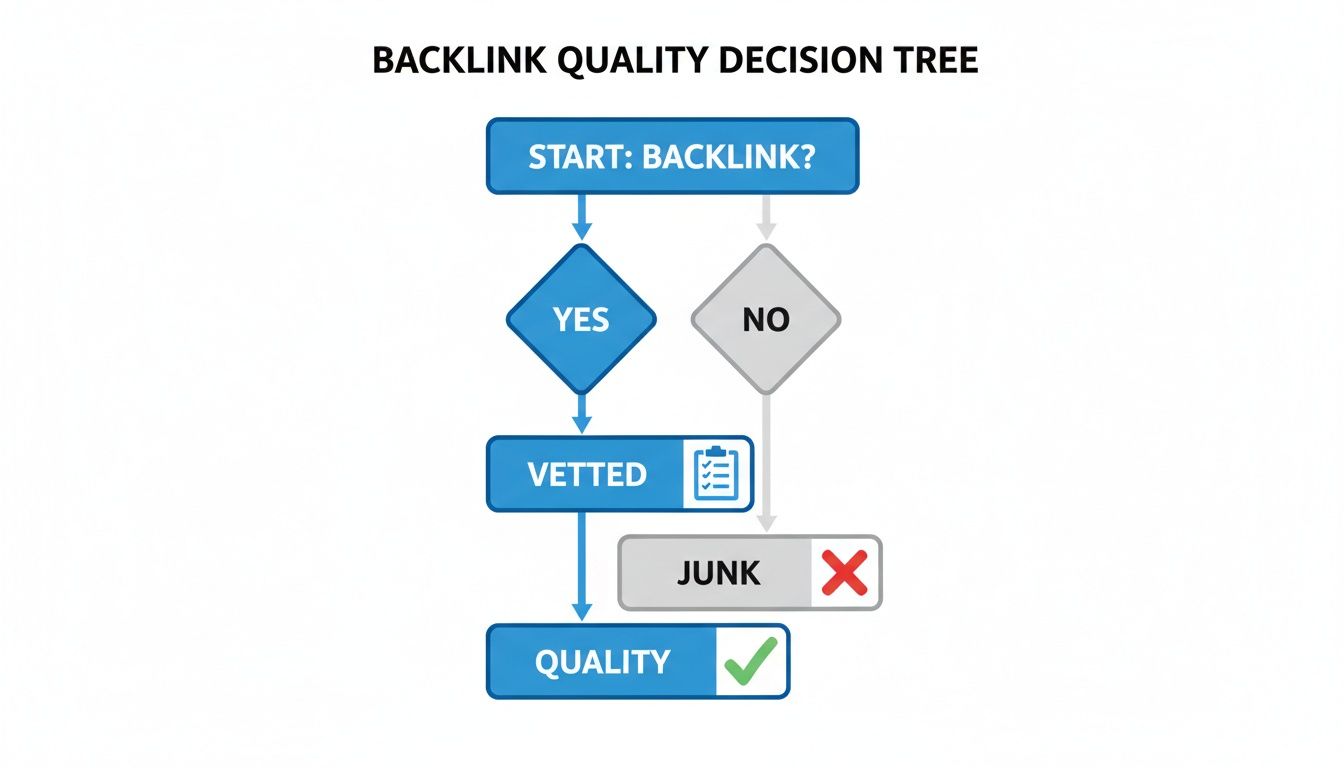
The flow is simple: after you spot a target, you vet it. Thoroughly. This step is what separates a quality asset from a complete waste of time.
Here's an example of the broken link method in action.
Subject: A broken link on your [Page Title] page
Hi [Contact Name],
I was researching [Topic] today and your resource page was a huge help: [Link to Page].
It’s a fantastic collection. While I was on the page, I noticed the link to "[Anchor Text of Broken Link]" seems to be dead—it just goes to a 404 error.
We just published a guide on [Topic] that might be a good replacement if you're looking for one: [Link to Your Resource].
Either way, just thought you'd want to know. Hope it helps!
Best, [Your Name]
Notice the posture? It's helpful first, self-serving second. This approach shows you're not just another SEO spammer crawling the web for links. You're behaving like a valuable member of the community, and that is precisely what gets rewarded with a response—and a backlink that’s actually worth something.
So, you did it. You landed a killer backlink edu gov placement. Pop the champagne, right? Not so fast.
Getting the link is a huge win, but the job isn't finished. Now you shift from hunter to analyst. The biggest mistake I see people make is getting distracted by vanity metrics. Watching your Domain Authority score creep up a few points feels good, but it doesn't pay the bills.
True success is measured by tangible results that affect your bottom line. We need to get granular with analytics to see what that new authority is actually doing for your site. The real value isn't the immediate "juice"; it's the long-term, sustainable growth these links can drive.
Tracking What Really Matters
Once that powerful backlink is live, your focus needs to pivot to three core areas. This is how you prove ROI and make smarter bets on your next campaign.
Don't just cross your fingers and hope for the best. Track these effects diligently:
- Ranking Improvements: Start by monitoring the search rankings for the specific page that got the link. Are you seeing a lift for its primary and secondary keywords? A truly powerful link should give that page a real boost for its target queries.
- Organic Traffic Growth: Keep a close eye on organic traffic to the linked page. Is it attracting more visitors from search over time? You should also look for a "halo effect"—that’s where other related pages on your site start seeing an uptick in traffic as your overall authority grows. It’s a beautiful thing when it happens.
- Referral Traffic: This is often a small number, but don't ignore it. The direct traffic that comes from someone clicking the link on the .edu or .gov site is highly qualified. Tracking how these users behave can give you incredible insights into their intent and engagement.
The most important virtue in this game is patience. The full SEO impact of a great backlink doesn't show up overnight. It can take weeks, sometimes even months, for search engines to fully process the signal and for you to see a real shift in rankings and traffic.
Common Pitfalls That Can Sabotage Your Success
Securing a high-authority link is only half the battle. The other half is not messing it up. I’ve seen plenty of well-intentioned SEOs sabotage their own wins by making easily avoidable mistakes. These slip-ups can wipe out the value of your hard work or, in a worst-case scenario, even get you penalized.
One of the most common blunders is getting a link from a penalized or forgotten corner of a legitimate domain. Not all pages on a university website are created equal. A link from some unmoderated student forum left to rot is worthless compared to one on a faculty resource page. Always vet the specific page, not just the domain.
Another classic error is getting greedy with your anchor text. Jamming an exact-match, keyword-stuffed anchor into your shiny new .gov link is like waving a giant red flag at Google. It screams, "I'm trying to manipulate rankings!" Keep it natural. Think branded anchors (like "NameSnag"), naked URLs, or natural phrases like "check out this guide."
Building a Clean and Sustainable Link Profile
A smart backlink strategy isn't about one or two big wins. It's about building a diverse, natural, and authoritative link profile over the long haul. While you're hunting for those prize .edu and .gov domains, don't forget about other legitimate tactics that build brand authority.
For instance, knowing how to optimize a press release for SEO can contribute to broader brand visibility and authority, which nicely complements your direct backlink efforts.
To keep your link profile clean and avoid common scams, just remember these ground rules:
- Avoid Paid Link Schemes: Never, ever pay for a spot on a "resource page" that's clearly just a list of paid links. These are toxic link farms, plain and simple.
- Steer Clear of Useless Links: Ignore all those offers for blog comments, forum signatures, or mass directory submissions. They've been worthless for years and are a hallmark of low-quality SEO services that will only get you in trouble.
- Prioritize Quality Over Quantity: One contextually relevant link from a trusted university page is worth more than 100 spammy directory links. Focus your time and money where it will actually make a difference.
By measuring your impact correctly and steering clear of these pitfalls, you ensure every backlink edu gov you earn becomes a lasting asset that drives real, measurable growth.
Alright, let's cut through the noise. People get weird about .edu and .gov backlinks. They’re often treated like some sort of mythical SEO beast, so let’s get a few things straight. I'm going to give you the direct, no-fluff answers to the questions I hear all the time. This should help you figure out your own strategy and manage what to expect.
Are EDU and GOV Links Still Worth Anything in 2026?
Yes, absolutely. But not for the reason most people think.
It's true Google has said there's no magic ranking button just because a link ends in .edu or .gov. If you take that statement at face value, you miss the entire point. The real value is in what those domains represent.
Think about it. These aren't just random blogs. Universities and government agencies have ridiculously high editorial standards. Their purpose isn't commercial. A link from one of them is a massive signal of credibility. It's a direct feed into Google's E-E-A-T framework—a powerful endorsement from some of the most trusted organizations on the entire internet.
Is Buying an Expired Domain with These Links a Safe Bet?
It can be, but you need to put on your detective hat. Snagging an expired domain that already has powerful .edu or .gov links is a fantastic shortcut to authority. It's also a fantastic way to light your money on fire if you don't know what you're doing.
A clean, relevant expired domain is SEO gold. A domain with a history of spam or penalties, however, is a ticking time bomb for your main website.
Crucial Vetting Step: Before you even think about buying, you have to do your homework. Use tools like the Wayback Machine to see what the site used to be. Dig into its entire backlink profile and look for any red flags—toxic links, spammy anchors, anything that smells off. A penalized domain is a liability you simply can't afford.
Outreach vs. Buying Expired Domains: Which Is Better?
This is the classic "build vs. buy" argument, and the honest answer is usually "both." They're two different tools for two different jobs.
Outreach is your scalpel. You're building a direct link from a high-authority site straight to a specific page on your primary "money" site. It's perfect for giving a targeted boost to a key piece of content. The big downside? It's slow, and success is never guaranteed. You'll send a lot of emails that go straight to the trash.
Buying an expired domain is more like acquiring a pre-built asset. It's much faster, and you get an asset you completely control. You can 301 redirect it to pass authority to your main site or even build it out as a separate authority site in your niche.
Frankly, a hybrid approach almost always wins. Keep your long-term outreach campaigns running in the background. While you're doing that, keep an eye out for strategic expired domains you can acquire to get a quick injection of authority.
Ready to find high-value domains with existing authority? Let NameSnag do the heavy lifting. Instead of sifting through digital junk, use our powerful filters to find Available domains with clean histories or scout for powerful Expiring domains before they hit the open market.
Find Your Perfect Domain
Get access to thousands of high-value expired domains with our AI-powered search.
Start Free Trial