A one-word domain is the internet's equivalent of prime real estate. Think of it as owning the most sought-after address in a major city. It's an address made of a single, memorable word like Mint.com or Slack.com. It’s rare, it’s prestigious, and it instantly communicates authority.
The Power of a Single Word

In a world drowning in information, simplicity is the ultimate superpower. A one-word domain cuts through the noise like nothing else. It’s more than just a web address; it's a bold statement of confidence and market leadership. When someone types a single, dictionary word into their browser, they expect to land on the definitive source for that topic.
This psychological shortcut is incredibly powerful. Imagine you're looking for information on mortgages. Which domain sounds more authoritative: "Mortgage.com" or "YourBestMortgageDealsOnline.com"? The first one feels like the destination. The second feels like just another option in a sea of many.
Why Simplicity Wins in Branding
The internet is obsessed with these domains because they tap into how our brains actually work. We're wired to remember simple, concrete concepts. A single word is easy to recall, spell, and share, giving any business a massive head start in building a memorable brand.
One-word .coms have long been the crown jewels of the domain market, and their value has only shot up as the supply of good ones has vanished. Historically, the most valuable were generic and highly brandable—names like Insurance.com and Beer.com have sold for millions. You can dig into the domain name statistics to see just how much these values have climbed.
A one word domain isn't just a name; it's a category killer. It implies that you don't just participate in the market—you are the market.
For a clearer picture, let's break down how these premium domains stack up against their longer counterparts.
One Word Domain vs Multi-Word Domain At a Glance
The table below offers a quick comparison, highlighting the distinct advantages that make single-word domains such a coveted asset for branding and marketing.
| Attribute | One Word Domain | Multi-Word Domain |
|---|---|---|
| Memorability | Extremely high; easy to recall and type. | Lower; prone to spelling errors and confusion. |
| Brand Authority | Instantly perceived as a market leader. | Authority must be built over time. |
| Marketing Cost | Lower; the name itself is a marketing tool. | Higher; requires more effort to establish the brand. |
| Type-in Traffic | Significant potential for direct navigation. | Very little to none. |
| Credibility | High inherent trust and perceived stability. | Credibility is earned through other signals. |
| Availability | Extremely rare and expensive. | Widely available and affordable. |
As you can see, the trade-off is clear: multi-word domains are accessible, but one-word domains deliver a powerful, built-in strategic advantage right out of the gate.
The Unspoken Advantage
Beyond pure branding, a one word domain carries a sense of trust and permanence. It suggests a company that was savvy enough to get the best digital real estate early, signaling foresight and stability. This perceived authority translates into real, tangible benefits:
- Instant Credibility: Users automatically assume a higher level of expertise from a brand with such a direct and powerful domain.
- Effortless Marketing: The domain name itself does a lot of the heavy lifting, making it easier for customers to find and remember you.
- Higher Type-In Traffic: People are far more likely to guess and type a generic term directly into their browser, driving valuable organic traffic your way.
Ultimately, owning a one-word domain is like having a permanent billboard on the busiest intersection of the internet. It works for you 24/7, building your brand and establishing you as a leader before a visitor even sees your homepage.
The Branding and SEO Advantages You Cannot Ignore
A one-word domain isn't just a web address. It's a strategic asset that works for you 24/7, shaping how people see your business before they even click a link. This kind of digital real estate packs a serious one-two punch, handing you a massive advantage in both branding and search engine optimization (SEO). Let's unpack these two superpowers.
From a branding perspective, owning a single, powerful word creates instant credibility. It’s the difference between being an option in the market versus being the authority. When you own a domain like "Frame.com" or "Voice.com," you aren't just another company—you're signaling that you're the default destination. That positions you as a market leader from day one.
This kind of built-in authority is priceless. It cuts right through the marketing noise and builds a foundation of trust that would otherwise take years and a huge budget to establish. Think of it as your digital handshake; it's strong, confident, and leaves a lasting impression.
The Branding Superpower
A great brand is built on being memorable and trustworthy, and a one-word domain hits the accelerator on both. It’s simple, direct, and incredibly easy to share by word of mouth. No hyphens to remember, no clever misspellings to explain.
The benefits are real and you'll feel them immediately:
- Effortless Recall: A single, common word is far easier for customers to remember and type directly into their browser. This drives valuable type-in traffic, where users skip search engines entirely to come straight to you.
- Perceived Leadership: Owning the definitive word for your industry implies foresight and stability. It sends a powerful message that your business is a serious, long-term player.
- Marketing Efficiency: Your domain name becomes a core part of your marketing. It’s short enough for billboards, catchy enough for radio ads, and professional enough for any business card.
Owning a one-word domain is like having a permanent billboard on the busiest intersection of the internet. It works for you constantly, building your brand and establishing you as a leader before a visitor even sees your homepage.
This branding power creates a halo effect that makes all your other marketing efforts work harder. When your name is the category, you're always one step ahead.
The Hidden SEO Edge
While Google has said for years that exact match domains don't get the same algorithmic boost they once did, the indirect SEO benefits of a one-word domain are impossible to deny. These advantages are all about human behavior and the natural authority these domains tend to pick up over time.
For starters, many of these domains are ancient by internet standards. An older domain often has a clean, established history that search engines already trust. That's a huge leg up on a brand-new domain that has to build its reputation from scratch.
More importantly, these domains are backlink magnets. Journalists, bloggers, and industry experts are just more likely to link to "Shoes.com" when talking about footwear than to some long, clunky alternative. These kinds of authoritative links are pure SEO gold.
Think about these key SEO factors:
- Higher Click-Through Rate (CTR): In a crowded page of search results, a short, authoritative domain just stands out. People are more likely to click on a link that looks trustworthy and directly relevant.
- Natural Link Equity: A premium one-word domain picks up high-quality backlinks organically because it's seen as the definitive source on a topic.
- Direct Traffic Signals: High levels of direct, type-in traffic send strong positive signals to search engines. It tells them your site is a popular and trusted destination that people seek out on their own.
Because these domains are so valuable, almost all of them are already registered. But you can occasionally find absolute gems by searching for Available domains that have recently dropped. An even savvier move is to keep an eye on Expiring domains to get a jump on valuable names before they hit the open market. This strategy lets you snap up a domain that already has an established history and backlink profile, giving your SEO a massive head start.
How to Properly Value a One-Word Domain
So, what's a single word actually worth? The answer can swing wildly from a few thousand dollars to a cool seven figures. Valuing a one-word domain isn't just about picking a number out of thin air; it’s a blend of art and science, and it takes a bit of experience to get right.
Think of it like appraising a piece of prime real estate. You wouldn't just look at the square footage. You'd analyze the neighborhood, the foot traffic, and its potential for commercial use. A domain's value goes far beyond the word itself, and this guide will give you a reliable framework to separate a priceless digital asset from a costly mistake.
The right domain creates a powerful cascade effect. It strengthens your branding and SEO, which in turn builds credibility with your audience and drives a steady stream of traffic.
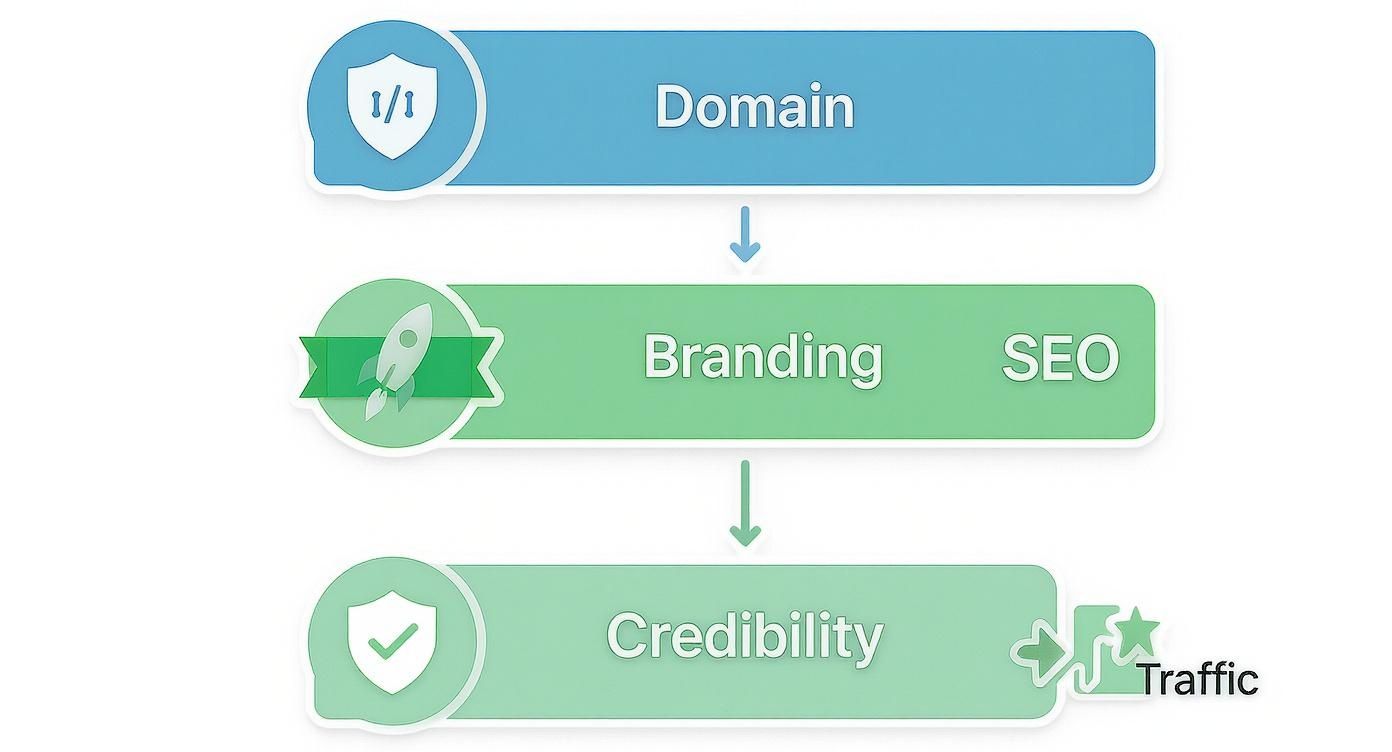
As you can see, a great domain is the bedrock. It’s where your brand authority and search rankings begin, leading directly to higher trust and more organic visitors.
Unpacking the Commercial Appeal
The first—and most important—factor is the word’s commercial intent. It's just common sense: a domain like "Loans.com" has a much higher intrinsic value than "Pebbles.com" because one is directly tied to a multi-billion dollar industry.
To gauge this, ask yourself a few key questions:
- Is it an industry keyword? Words like "insurance," "travel," or "software" are category-defining. They're instantly valuable.
- Is it a product or service? Think "Shoes.com" or "Coffee.com." These are directly transactional and leave no room for confusion.
- Is it a brandable verb? Domains like "Join.com" or "Mint.com" are incredibly versatile. They can be molded into powerful brand identities that stick.
A word with high commercial relevance is a magnet for motivated buyers, which naturally drives up its price. Simple supply and demand.
Analyzing the Search Data
Gut feelings are a starting point, but hard data is your best friend in valuation. Two of the most critical metrics are search volume and Cost Per Click (CPC). Search volume tells you how many people are looking for that term each month, while CPC reveals how much advertisers are willing to pay for a single click on an ad for that keyword.
A high CPC is a massive indicator of commercial value. If companies are paying $20, $50, or even $100+ per click, you can be sure that keyword is incredibly profitable. This advertising data gives you a concrete, market-driven baseline for the domain's worth.
A high CPC acts like a financial "tell" in poker. It reveals just how much money is flowing through that keyword, giving you a powerful clue about the domain's underlying value.
Performing Technical Due Diligence
Not all old domains are valuable. Some come with a toxic history that can kill your SEO efforts before they even start. Before you even think about making an offer, you need to put on your detective hat and run some crucial technical checks.
These checks are non-negotiable for anyone serious about domain name investment and can save you from a world of headaches. Here’s what you absolutely must investigate:
- Domain Age: Older domains are generally better, as they've had more time to build authority. An age of 5+ years is a good starting point, but many premium one-word domains have been registered for decades.
- Backlink Profile: This is the big one. You need to vet the domain's backlinks for spam. A history of links from low-quality, shady, or irrelevant sites can be a major red flag for search engines. Look for a clean profile with links from reputable sources.
- Trademark Screening: Is the word trademarked? Acquiring a domain that infringes on an existing trademark is a recipe for a legal disaster. Always run a thorough trademark search to ensure the name is clear for use in your intended industry.
Failing to perform these checks is like buying a house without an inspection. You might get lucky, but you're more likely to inherit a host of expensive, hidden problems. By combining commercial analysis with hard data and technical diligence, you can confidently determine the true value of any one-word domain.
An Action Plan for Finding Your One Word Domain
Okay, so you get it. You see the value in a one-word domain and you're ready to start hunting for your own digital unicorn. But where do you even start? It’s true, most of the absolute best one-word domains were scooped up decades ago, but that doesn't mean the game is over.
It just means you need to play smarter.
Finding a killer one word domain is part treasure hunt, part detective work. It takes patience, the right tools, and a healthy dose of luck. Manually checking registrars day in and day out? Forget it. That’s like panning for gold with a teaspoon. We’re going to use a metal detector.
The modern approach is all about monitoring two key moments in a domain's life: the second it becomes available, and the crucial period just before it does. That's where you find the incredible opportunities everyone else misses.
Master the Art of the Drop Catch
The most direct way to snag a fantastic domain is to catch it the exact moment it "drops." This happens when an owner fails to renew their domain, it goes through a grace period, and is finally released back into the wild for anyone to register. This is where the magic happens.
Thousands of domains drop every single day. Buried in that mountain of noise are some absolute gems. The trick is filtering out the 99% of junk to find that golden 1%. To do that, speed and automation are your best friends.
A powerful move is to search specifically for Available domains that have just been released. These are names you can register immediately, right now, at any standard registrar. Setting up a search to find available one-word domains that dropped Today gives you a massive first-mover advantage. You can grab a premium name before most people even know it's back on the market.
Get Ahead with Expiring Domains
While drop catching is a great tactic, the real pro move is to get ahead of the competition. Why wait for a domain to become available when you can track it before it even drops?
Monitoring Expiring domains gives you an almost unfair strategic edge. These are domains that have expired but are still stuck in a grace or redemption period. The owner might still renew it, sure, but a lot of the time, they don't. By keeping an eye on these names, you can get your acquisition strategy ready to go well in advance.
This approach lets you:
- Do Your Homework: You have time to dig into the domain's history, check its backlink profile for spam, and verify its SEO metrics without the frantic pressure of a live auction.
- Prepare for Auction: Many high-value expiring domains go to auction. When you spot them early, you can set your budget and be ready to bid the moment the gavel drops.
- Avoid the Crowds: You’re acting on information the general public isn't watching, giving you a serious head start on identifying top-tier assets.
Think of it like scouting for talent. You don't wait for a star player to become a free agent; you identify promising prospects early and get ready to make your move.
Your Tactical Toolkit for the Hunt
Having the right strategy is one thing; pulling it off is another. You need tools that do the heavy lifting and bring the best opportunities right to you. Here’s a step-by-step process to put this whole plan into action.
- Set Up Keyword Alerts: Stop browsing endless lists. Start creating specific alerts for words or themes that matter to your industry. Building a fintech brand? Set up alerts for words like "cash," "fund," "pay," or "coin." This flips your search from reactive to proactive.
- Use a Scoring System: Manually sifting through hundreds of domains is a fast track to burnout. Use a platform with a built-in scoring system, like NameSnag’s SnagScore, to instantly filter for quality. This metric boils down complex factors like domain authority, age, and backlink strength into a single number, letting you see the best options at a glance.
- Run Automated Spam Checks: This is absolutely non-negotiable. A domain with a toxic backlink profile is an SEO landmine waiting to go off. Before you even think about buying a domain, make sure its history is clean. A built-in spam checker saves you from the soul-crushing task of vetting every link by hand and protects your investment from nasty hidden penalties.
Combining these tactics transforms your search from a game of chance into a calculated strategy. And if you're looking to build a powerful online presence from scratch, understanding what makes a name great in the first place is crucial. You can dive deeper with our complete guide on how to choose a brandable domain name to really sharpen your evaluation skills.
By focusing on both available and expiring domains, you literally double your chances of finding that perfect one-word gem—the one that becomes the foundation of an unforgettable brand.
Inspiring Brands Built on One Word Domains
Theory is one thing, but seeing a strategy pay off in the real world is what really gets the gears turning. The stories behind some of the world's most successful brands often start with a bold, simple choice: a one word domain. These weren't just happy accidents; they were calculated moves that became the foundation for empires.
Let’s look at some titans of industry. These companies didn't just buy a domain; they claimed a piece of our mental real estate. Their single-word addresses amplified marketing, built instant user trust, and cemented their brand equity in a way that longer, clunkier names never could.
These examples show the tangible, game-changing impact of securing the perfect domain.
The Titans of Simplicity
When you hear the names "Uber," "Slack," or "Mint," the domain is the brand, and the brand is the domain. This seamless identity is the holy grail of marketing, and it all started with one powerful word.
- Uber.com: The name itself means "outstanding" or "supreme." Before Uber, the word was just an adjective. Now, it's synonymous with ride-sharing worldwide. Owning this domain allowed them to completely redefine a word, making their brand the category leader by default. Any competitor had to position themselves as an "Uber-like" service.
- Slack.com: In a world of complicated business communication tools, the name "Slack" felt refreshingly simple and human. The domain is easy to say, spell, and share. It became the go-to verb in offices everywhere—"Just Slack me"—creating a marketing engine powered by daily conversation.
- Mint.com: This name is brilliant on multiple levels. It evokes feelings of money, freshness, and pristine condition. For a personal finance app, it's the perfect metaphor. The domain Mint.com instantly communicates value and simplicity, helping it cut through the clutter of a crowded fintech market and build trust with users managing their sensitive financial data.
These brands didn't just find a good name; they claimed a core concept. Their one-word domain became an unshakeable foundation, making them the default authority in their space.
This kind of branding power isn't just for billion-dollar giants. Nimble startups and niche businesses have used the same playbook to punch far above their weight.
The Smart Startups and Niche Dominators
You don't need a massive valuation to appreciate the power of a great one-word domain. For smaller companies, it can be the ultimate slingshot for taking on established Goliaths.
Consider a company like Frame.com, a video collaboration platform. By securing such a fundamental and relevant word, they immediately appear established and authoritative. It lends them a level of credibility that a name like "EasyVideoCollabTool.com" could never achieve, helping them compete with tech giants.
Or think of Drift.com, a conversational marketing platform. The word "drift" perfectly captures the fluid, natural flow of a conversation. Their domain isn't just a label; it’s a story. It helps them stand out in a sea of generic B2B software names and connect with customers on a more intuitive level.
These stories all share a common thread. The founders understood that a premium domain is an investment, not an expense. It's a strategic asset that pays dividends in credibility, memorability, and marketing efficiency for years to come. Finding one of these gems isn't easy, but by patiently monitoring Expiring domains for names that are about to drop, you can uncover incredible opportunities to build your own iconic brand.
What to Do After You Acquire Your Domain
So, you did it. You hunted down and snagged a killer one word domain. After the thrill of the chase dies down, you might be looking at your prize and thinking, "Okay... now what?" This is where the real fun begins—turning that piece of digital real estate into a serious asset.
What you do next boils down to one simple question: What's the goal? Your game plan will look completely different if you're a founder building a brand, an SEO pro chasing rankings, or an investor looking to turn a profit. Let's break down the playbook for each.
For Founders Building a Brand
As a founder, that new domain is the cornerstone of your entire brand identity. You just bought a prime plot of land; now it's time to build the house.
- Plaster It Everywhere: Your domain needs to be front and center, immediately. Update your logo, slap it in your email signatures, change your social media profiles, and get it on all your marketing materials. The idea is to make the name and the business feel like the exact same thing—inseparable.
- Tell the Story: Don't just own the word, own it. Use your "About Us" page to explain why you chose that specific word. This isn't just fluff; it creates a narrative that connects customers to your brand on a much deeper level. It turns a simple URL into a core part of your company's legend.
For SEO Professionals
If you're in the SEO game, you've just picked up a very powerful tool. A lot of these aged domains come with some authority baked in, but you have to be careful. You could be inheriting years of baggage along with the good stuff.
A premium domain can give you an incredible head start in the SERPs, but only if its foundation is clean. Inheriting a spammy backlink profile is like building on quicksand—it's a recipe for disaster.
Before you even think about launching a new site, your first move is a deep backlink audit. Find every toxic, sketchy, or just plain weird link pointing to that domain and get rid of it. It's also smart to use a specialized tool to get the full picture of its history. We break down why this is so critical in our guide on using a domain spam score checker. Once you've scrubbed it clean, you can start building out high-quality content that actually deserves the authority that name carries.
For Domain Investors
For an investor, a one-word domain is a blue-chip stock in your portfolio. Your job is to figure out the best way to get a return on that investment, and you've got a few solid options:
- Develop and Flip: Put up a simple, high-quality niche site on the domain. Even a basic site with a trickle of traffic and a few dollars in revenue is infinitely more valuable to a potential buyer than a blank, parked page.
- Park and Hold: If the word has huge commercial appeal and you're betting its value will climb, parking it is a legitimate long-term play. It's a lower-effort strategy for assets you believe will appreciate significantly over time.
- Lease to a Business: Find a startup or an established company that could use the branding boost and offer to lease them the domain. This strategy creates a steady, passive income stream while you hold onto the underlying asset.
Got Questions About One-Word Domains?
You're not alone. The world of premium domains can feel a little wild, so let's tackle the questions that come up most often.
How Much Should I Budget for a One-Word Domain?
That’s the million-dollar question—and sometimes, the answer is literally a million dollars. The price swings wildly from a few thousand for less common words to well into seven figures for terms with huge commercial value.
There's no simple price tag. Everything from search volume and industry appeal to the domain's age plays a part. You have to value each one on its own merits.
Is It Safe to Buy an Expired Domain?
Absolutely, as long as you do your homework first. Snagging a good expired domain can feel like a massive cheat code, giving you a head start with established authority and backlinks.
The catch? You have to vet its history like a detective. A clean profile is a huge asset, but a toxic one is a liability you don't want.
What Is the Transfer Process Like?
It's surprisingly straightforward and usually wrapped up in about 5 to 7 days. Once you buy the domain, the seller gives you an authorization code (or "auth code"). You just pass that code to your favorite registrar, and they handle the rest.
It's a secure, standardized process that's been done millions of times.
The transfer itself is the easy part. The real work—the most important work—is the due diligence you do before you ever click "buy." A smooth transfer of a bad domain is still a bad investment.
Can I Find Good One-Word Domains for Free?
Okay, you’re not going to stumble upon "Insurance.com" for the standard registration fee. But you can find incredible value by catching "dropped" domains—the ones that weren't renewed and are released back to the wild.
By keeping an eye on newly Available domains, you can sometimes register a fantastic one-word domain for the price of a coffee, completely bypassing the pricey aftermarket. It takes patience and a bit of luck, but the payoff can be huge.
Ready to find your own one-word domain? NameSnag uses powerful analytics to scan over 170,000 domains daily, helping you find valuable dropped and expiring domains with real SEO potential.
Find Your Perfect Domain
Get access to thousands of high-value expired domains with our AI-powered search.
Start Free Trial